
Best Ceiling Speaker Placement for Living Rooms
In this comprehensive guide, we'll dive into the best practices for positioning your ceiling speakers, the importance of ceiling speaker placement for living rooms.

Are you looking to create an immersive audio experience in your living room with ceiling speakers? Proper 7.1 surround sound ceiling speaker placement is crucial for achieving optimal sound quality and coverage. In this comprehensive guide, we'll dive into the best practices for positioning your ceiling speakers, the importance of ceiling speaker placement for living rooms, and how XTEN-AV's Ceiling Speaker Layout and Calculator can simplify the process. We'll also explore the benefits of using AV system integration software to design your audio setup.
Why Ceiling Speaker Placement Matters in Living Rooms
The placement of your ceiling speakers plays a significant role in the overall audio experience in your living room. Here are a few reasons why getting it right is so important:
Balanced Sound Coverage: Proper speaker placement ensures that sound is evenly distributed throughout the room, eliminating dead spots or areas with overwhelming volume.
Immersive Audio: With the right configuration, ceiling speakers can create a truly immersive surround sound experience, making you feel like you're in the middle of the action.
Aesthetic Appeal: Well-placed ceiling speakers blend seamlessly into your living room's décor, providing great sound without detracting from the room's visual appeal.
Optimal Performance: Positioning your speakers correctly allows them to perform at their best, delivering clear, precise audio that enhances your favorite movies, TV shows, and music.
Now that we understand the importance of ceiling speaker placement let's explore some key considerations and best practices.
Factors to Consider When Placing Ceiling Speakers
Before we dive into the specific placement guidelines, it's essential to consider several factors that can impact your speaker setup:
Room Size and Shape
The size and shape of your living room will influence the number of speakers you need and their ideal placement. Larger rooms may require more speakers to achieve adequate coverage, while smaller spaces may benefit from a more compact setup.
Ceiling Height
The height of your ceiling affects how sound waves travel and disperse throughout the room. Higher ceilings may require speakers with a wider dispersion angle to ensure even coverage.
Speaker Specifications
Each speaker model has unique specifications, such as dispersion angle, frequency response, and power handling. These factors can impact placement decisions and overall performance.
Listening Position
Consider your primary listening position when placing your ceiling speakers. You'll want to optimize the setup for the areas where you'll be spending the most time enjoying your audio content.
Best Practices for Ceiling Speaker Placement
Now that we've covered the key factors to consider, let's explore some best practices for placing your ceiling speakers in a living room setting.
7.1 Surround Sound Ceiling Speaker Placement
For a 7.1 surround sound ceiling speaker placement, you'll typically need the following:
Front Left and Right Speakers
Center Channel Speaker
Surround Left and Right Speakers
Rear Surround Left and Right Speakers
Subwoofer
Here's a general guide for positioning these speakers:
Front Left and Right: Place these speakers slightly in front of and angled towards your listening position, about 30-45 degrees off-center.
Center Channel: Position this speaker directly above or slightly in front of your TV or screen, aimed at the listening position.
Surround Left and Right: Place these speakers to the sides of your listening position, slightly above ear level and angled towards the listeners.
Rear Surround Left and Right: Position these speakers behind the listening area, angled towards the listeners and slightly above ear level.
Subwoofer: The subwoofer's placement is less critical, as low frequencies are omnidirectional. However, placing it near a wall or in a corner can enhance bass response.
Remember to adjust these positions based on your specific room layout and the speaker's dispersion characteristics.
Dolby Atmos and Immersive Audio Setups
If you're looking to create an even more immersive audio experience, consider a Dolby Atmos or other immersive audio setup. These configurations typically involve additional height speakers placed overhead. Here are some tips:
Overhead Speakers: Place four overhead speakers in a rectangular formation, with each speaker equidistant from the listening position and angled towards it.
Front and Rear Height Speakers: If using front and rear height speakers instead of overhead speakers, position them above the front left/right and rear surround speakers, angled towards the listening area.
Speaker Elevation: Dolby recommends placing height speakers at a minimum elevation angle of 30 degrees relative to the listening position for optimal performance.
Using XTEN-AV's Ceiling Speaker Layout and Calculator
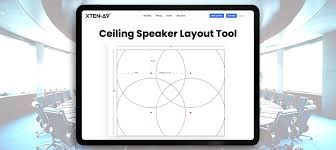
While the guidelines above provide a solid foundation, every room is unique, and achieving the perfect speaker placement can be challenging. That's where XTEN-AV's Ceiling Speaker Layout and Calculator comes in. This powerful tool simplifies the process of designing your ceiling speaker setup, ensuring optimal performance and coverage.
Why XTEN-AV Ceiling Speaker Layout and Calculator is the Best for Placing Ceiling Speakers in Living Rooms
Multi-Brand Compatibility & Vast Product Library: XTEN-AV supports thousands of audio-visual products from various manufacturers, allowing you to select the perfect speakers for your living room, regardless of brand.
Precision Layout Based on Industry Standards: The calculator uses advanced algorithms based on AVIXA standards to determine the ideal speaker placement, considering factors like ceiling height, speaker dispersion, and desired coverage pattern.
Instant 2D and 3D Visual Layouts: Visualize your speaker setup with detailed 2D floorplans and immersive 3D renderings, making it easy to fine-tune your design and communicate with installers or clients.
Quick and Easy to Use: With a user-friendly interface and no CAD skills required, XTEN-AV makes it simple for anyone to create a professional-grade ceiling speaker layout.
Compliance with Acoustic Design Standards: XTEN-AV ensures your speaker placement adheres to industry guidelines for spacing, performance, and coverage uniformity, guaranteeing optimal sound quality.
Versatility for Residential and Commercial Spaces: Whether you're designing a home theater, conference room, or retail store, XTEN-AV adapts to your specific needs and room characteristics.
Superiority to Brand-Specific Tools: XTEN-AV offers unmatched flexibility, visualization capabilities, and cross-system integration compared to manufacturer-specific calculators.
The Importance of AV System Integration Software
In addition to using XTEN-AV's Ceiling Speaker Layout and Calculator, incorporating AV system integration software into your design process can further enhance your living room audio setup. These tools offer benefits such as:
Comprehensive System Design: AV system integration software allows you to design your entire audio-visual system, including speakers, amplifiers, receivers, and control systems, ensuring seamless compatibility and performance.
Documentation and Collaboration: Generate detailed documentation, including system diagrams, wiring schematics, and equipment lists, making it easier to collaborate with installers, clients, and other stakeholders.
Virtual System Configuration: Configure and test your AV system in a virtual environment before installation, identifying potential issues and optimizing performance.
Efficient Project Management: Streamline your project workflow, from initial design to final commissioning, with features like task management, resource allocation, and progress tracking.
Frequently Asked Questions About Ceiling Speaker Placement
Q: How many ceiling speakers do I need for my living room? A: The number of speakers you need depends on the size of your room, your desired audio configuration (e.g., 5.1, 7.1, or Dolby Atmos), and the speaker's coverage capabilities. Use XTEN-AV's calculator to determine the optimal number based on your specific requirements.
Q: Can I use different brands of speakers in my ceiling speaker setup? A: Yes, you can mix and match speaker brands in your setup. However, it's essential to ensure that the speakers have compatible specifications (e.g., impedance, sensitivity) and that your amplifier or receiver can handle the combined load.
Q: How high should I mount my ceiling speakers? A: The ideal mounting height depends on your ceiling height and the speaker's dispersion characteristics. Generally, speakers should be placed at least 2-3 feet away from walls and corners and aimed towards the listening area. XTEN-AV's calculator takes ceiling height into account when generating layouts.
Q: What's the best way to run wires for ceiling speakers? A: The most common method is to run the wires through the attic or crawl space above the room. If this isn't possible, you can use wire molding or conduit to conceal the wires along the walls and ceiling. Always follow local building codes and hire a professional installer if you're unsure about the process.
Q: Can I paint my ceiling speakers to match my room's décor? A: Many ceiling speakers come with paintable grilles, allowing you to match them to your room's color scheme. However, be sure to use a paint that won't clog the speaker's perforations or affect its acoustic properties. Consult your speaker's manual or manufacturer for specific painting instructions.
Real-World Case Studies
Home Theater Transformation: John and Sarah wanted to upgrade their living room into a dedicated home theater space. Using XTEN-AV's Ceiling Speaker Layout and Calculator, they designed a 7.1.4 Dolby Atmos system with in-ceiling speakers from Bose and Klipsch. The result was a stunningly immersive audio experience that rivaled their local cinema.
Open-Concept Living Space: Michael had a challenge: creating a cohesive audio setup for his open-concept living room, dining area, and kitchen. With XTEN-AV, he was able to design a multi-zone system using Sonance and JBL speakers, ensuring even coverage and independent volume control for each area.
Conference Room Upgrade: A local business needed to improve the audio quality in their conference room for virtual meetings and presentations. Using XTEN-AV and an AV system integration software, they designed a sleek, professional-grade setup with Tannoy ceiling speakers and a Biamp DSP, creating a clear and intelligible audio environment.
Conclusion
Proper ceiling speaker placement is essential for achieving the best possible audio experience in your living room. By considering factors like room size, ceiling height, and speaker specifications, and following best practices for placement and configuration, you can create an immersive and engaging soundscape that enhances your favorite content. XTEN-AV's Ceiling Speaker Layout and Calculator is an invaluable tool for simplifying the design process and ensuring optimal results. With its multi-brand compatibility, precision layouts, and compliance with industry standards, it's the best solution for placing ceiling speakers in living rooms and beyond. Combining XTEN-AV with AV system integration software further streamlines the design and installation process, allowing you to create a truly seamless and high-performance audio setup. By following the guidelines and using the tools outlined in this comprehensive guide, you'll be well on your way to enjoying the ultimate in-ceiling audio experience in your living room.